






Ram 2500 vs. Ram 3500: Which Heavy Duty Truck Do You Actually Need?
Quick answer: Choose the Ram 2500 if you tow a conventional or lighter fifth-wheel trailer and want a better everyday ride. Choose the Ram 3500 if you regularly tow a heavy gooseneck or fifth-wheel, haul substantial weight in the bed, or need dual rear wheels. Payload — not towing — is usually the deciding factor.
Start with payload, not towing
Buyers almost always compare towing numbers first. That is the wrong starting point, because most people who outgrow a 2500 outgrow it on payload.
A fifth-wheel trailer transfers 15 to 25 percent of its loaded weight onto the truck bed through the pin. Add passengers, fuel, a hitch, tools and gear, and payload disappears quickly. It is entirely possible to be under the towing limit and over the payload limit at the same time — which is the configuration that wears out brakes, sags suspension and gets flagged at a weigh station.
Run the arithmetic before you shop:
- Take the trailer’s gross weight, not its dry weight.
- Multiply by 0.20 for an estimated pin weight.
- Add passengers, fuel, hitch hardware and cargo.
- Compare that total to the payload figure on the door-jamb sticker of the actual truck.
If the answer is close, the 3500 is the right truck.
Where the two trucks differ
| Ram 2500 | Ram 3500 | |
|---|---|---|
| Class | Three-quarter ton | One ton |
| Rear suspension | Coil spring standard | Leaf spring on higher-capacity builds |
| Dual rear wheels | Not offered | Available |
| Payload | Lower | Substantially higher |
| Max gooseneck towing | Lower | Highest in the lineup |
| Unloaded ride quality | Generally smoother | Firmer, built for load |
| Everyday drivability | Easier to park and maneuver | Wider with duals |
The suspension difference is the one people feel. The Ram 2500’s coil-spring rear setup is noticeably more comfortable empty, which matters if the truck is also a daily driver. The 3500’s higher-capacity configurations are tuned to be composed under load, which means they can feel firm when the bed is empty.
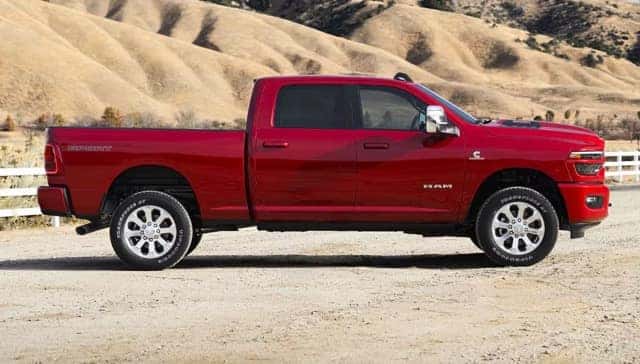 The case for the Ram 2500
- You tow a conventional travel trailer, boat or equipment trailer rather than a heavy gooseneck.
- The truck doubles as a family vehicle or commuter.
- You want a smoother unloaded ride.
- You park in tighter spaces where dually width is a liability.
- Purchase price and insurance matter and you do not need the extra capacity.
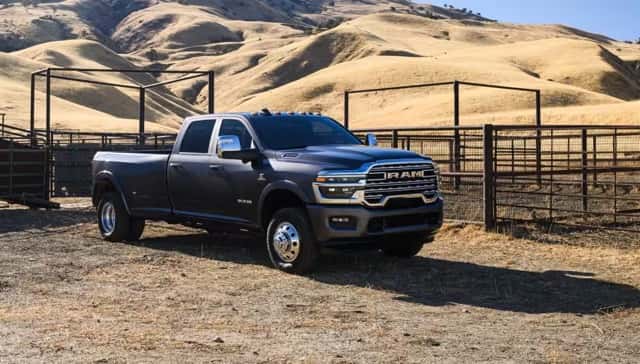 The case for the Ram 3500
- You tow a heavy fifth-wheel, gooseneck stock trailer or equipment trailer regularly.
- You carry a service body, flatbed, welder, tool crib or slide-in camper.
- Pin weight plus cargo pushes a 2500 near its payload ceiling.
- You want dual rear wheels for stability under load and a wider margin of safety.
- The truck is a work asset and capacity headroom is worth the cost.
What about the Chassis Cab?
If the truck is going to receive a flatbed, service body, dump body or other upfit, look at the Ram 3500 Chassis Cab rather than a pickup. It is built to be finished by an upfitter and comes with the frame provisions to do it properly. This is a common path for contractors, landscapers and service fleets around Birmingham.
Does the 3500 cost meaningfully more to own?
Purchase price differences between comparable 2500 and 3500 trims are typically modest. The larger cost differences show up elsewhere: dual rear wheel trucks need six tires instead of four, and heavy-duty diesel maintenance intervals — fuel filters, diesel exhaust fluid, oil capacity — cost more than a light-duty gas truck regardless of which one you buy.
If you are going to buy heavy-duty anyway, the incremental cost of stepping to a 3500 is usually smaller than buyers expect. Buying too little truck is the more expensive mistake. Compare new Ram 2500 and new Ram 3500 inventory side by side, and run both through the payment calculator before you decide.
Frequently asked questions
What is the main difference between a Ram 2500 and a Ram 3500? The Ram 3500 is a one-ton truck with higher payload capacity, higher maximum gooseneck towing and the option of dual rear wheels. The Ram 2500 is a three-quarter-ton truck with a coil-spring rear suspension that rides better unloaded.
Is a Ram 2500 enough for a fifth-wheel camper? Often yes for lighter fifth-wheels, but check pin weight against payload rather than trailer weight against towing capacity. Heavier fifth-wheels commonly exceed a 2500’s payload before they exceed its tow rating.
Does the Ram 3500 ride worse than the 2500? Unloaded, generally yes on the higher-capacity configurations, because the rear suspension is built to carry weight. Under load the difference narrows considerably.
Can you get dual rear wheels on a Ram 2500? No. Dual rear wheels are available on the Ram 3500 and Chassis Cab, not the 2500.
Which one is better for a work fleet? It depends on the job. Service bodies, upfits and heavy hauling point to the 3500 or Chassis Cab. Lighter service routes and crew transport are often better served by a 2500.
0 comment(s) so far on Ram 2500 vs. Ram 3500: Which Heavy Duty Truck Do You Actually Need?