






Ram 1500 vs. Ram 2500: Where the Line Between Half-Ton and Heavy Duty Actually Falls
Quick answer: Choose the Ram 1500 if the truck is primarily a daily driver that tows a boat or a light trailer occasionally. Choose the Ram 2500 if you tow a heavy trailer regularly, carry substantial weight in the bed, or need a truck that works hard every week. The 1500 rides better and costs less to run; the 2500 has meaningfully more payload and towing headroom.
Start with how the truck will actually be used
The honest way into this decision is to describe a typical week rather than a maximum capability.
If the truck commutes, hauls mulch a few times a year, and pulls a bass boat or a small camper on weekends, the Ram 1500 is almost certainly the right answer. It is a better vehicle to live with in every respect that does not involve heavy loads.
If the truck pulls a loaded equipment trailer several days a week, carries a slide-in camper, or tows a fifth-wheel, the 2500 is the right answer and buying a 1500 will be a false economy.
The problem case is the middle: people who tow near a 1500’s limit regularly. That is the situation where the 2500 earns its cost.
Side by side
| Ram 1500 | Ram 2500 | |
|---|---|---|
| Class | Half-ton, light duty | Three-quarter ton, heavy duty |
| Rear suspension | Coil spring; air suspension available | Coil spring, higher capacity |
| Payload | Lower | Substantially higher |
| Max towing | Strong for a half-ton | Substantially higher |
| Diesel option | Available in some model years | Cummins turbo diesel |
| Unloaded ride | Best in the pickup segment | Firmer, built for load |
| Fuel economy | Meaningfully better | Lower |
| Everyday drivability | Easier to park and maneuver | Larger and taller |
| Purchase price | Lower | Higher |
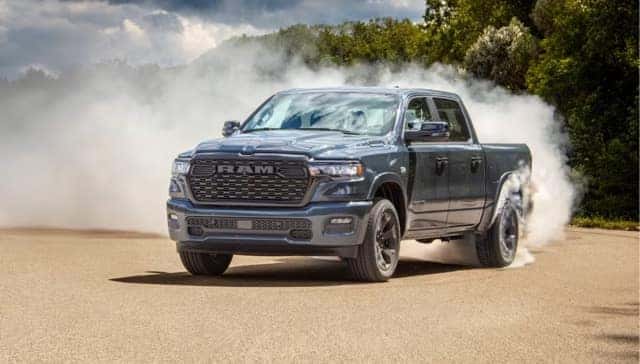
The ride difference deserves emphasis. The Ram 1500’s coil-spring rear suspension, and the available air suspension, make it one of the most comfortable pickups on sale. That is a real quality-of-life advantage for a truck that spends most of its time empty.
 Payload is where people get caught
The mistake is comparing towing numbers and stopping there.
A half-ton truck’s towing rating usually looks generous. Its payload rating is the tighter constraint, and payload is what gets consumed by trailer tongue weight, passengers, fuel, a hitch and anything already in the bed.
A conventional trailer puts roughly 10 to 15 percent of its weight on the hitch. A fifth-wheel puts 15 to 25 percent directly into the bed. Add four people and a full tank, and a well-equipped crew cab 1500 can be at its payload limit with a trailer well under its towing rating.
Work the numbers with your actual trailer’s loaded weight — not its dry weight — and compare against the payload figure on the door-jamb sticker of the specific truck. That single calculation answers this question more reliably than any comparison article.
Where the 1500 clearly wins
- Daily comfort. Better ride, quieter cabin, easier to park.
- Fuel economy. A meaningful ongoing cost difference.
- Purchase price. Lower to buy and generally to insure.
- Garage fit. Lower overall height matters for some homes.
- Interior. Higher 1500 trims are genuinely luxurious.
Where the 2500 clearly wins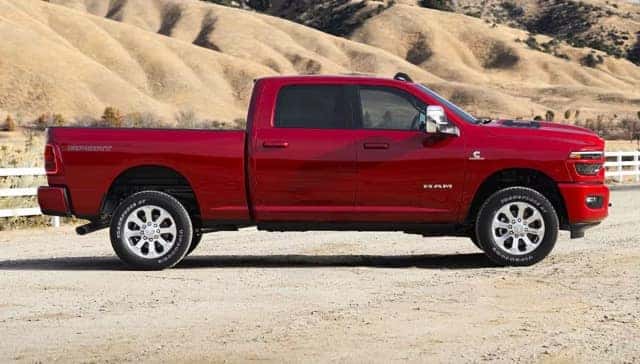
- Payload headroom, which is the real reason to step up.
- Heavy towing, particularly gooseneck and fifth-wheel.
- Durability under sustained load. Heavy-duty brakes, cooling and driveline built for repeated hard work.
- The Cummins diesel option, with the torque and exhaust braking that heavy towing rewards.
- Resale, particularly on diesel trucks in a work market.
What about the 3500?
If you are reading this comparison and finding yourself drawn to the 2500 for heavy towing, it is worth knowing that the step from 2500 to 3500 is smaller in cost than the step from 1500 to 2500 — and it adds dual rear wheel availability and considerably more payload again. Our separate Ram 2500 versus Ram 3500 comparison covers that decision in detail.
The general rule across the range: buying one class too much truck costs you fuel economy and ride comfort. Buying one class too little costs you brakes, suspension and eventually the truck.
Running costs to plan for
Fuel. The most visible difference. A half-ton driven daily costs noticeably less to run than a heavy duty.
Tires. Heavy-duty tires cost more per set and are load-rated accordingly.
Diesel maintenance. If you go diesel, budget for larger oil capacity, fuel filters and diesel exhaust fluid. These are known, scheduled costs rather than surprises, but they are real.
Insurance and registration. Worth getting quotes on both before deciding, particularly if the truck is going into a business.
Compare new Ram 1500 and Ram 2500 inventory side by side, step up to the Ram 3500 if the numbers point that way, and run the figures through the payment calculator. If the truck is going into a business, the Commercial Vehicle Center handles upfits and fleet purchasing.
Frequently asked questions
What is the difference between a Ram 1500 and a Ram 2500? The Ram 1500 is a half-ton light-duty pickup built to balance capability with daily comfort. The Ram 2500 is a three-quarter-ton heavy duty with substantially higher payload and towing capacity, a firmer ride and the Cummins diesel option.
Is a Ram 1500 enough for towing a camper? For lighter travel trailers and boats, usually yes. Check the trailer’s loaded weight and tongue weight against the specific truck’s payload rating rather than its towing rating, since payload is the tighter constraint on a half-ton.
Does the Ram 2500 ride worse than the 1500? Unloaded, yes. The 1500’s suspension is tuned for comfort and is among the best in the pickup segment. The 2500’s suspension is built to carry weight, and the difference narrows considerably under load.
Which is cheaper to own, a Ram 1500 or a Ram 2500? The 1500 is cheaper to buy, cheaper to fuel and generally cheaper to maintain. The 2500 costs more to run but holds value well, particularly in diesel form in a work market.
Should I buy a Ram 2500 or a Ram 3500? If you need dual rear wheels, maximum payload or heavy gooseneck towing, the 3500. The cost step from 2500 to 3500 is smaller than most buyers expect, so if you are near a 2500’s limits, the 3500 is often the better decision.
0 comment(s) so far on Ram 1500 vs. Ram 2500: Where the Line Between Half-Ton and Heavy Duty Actually Falls