






When to Replace Your Tires, How Often to Rotate, and Why Cold Weather Drops Your Pressure
Quick answer: Replace tires when tread depth reaches 2/32 of an inch, when they show sidewall cracking or bulges, or when they pass roughly six years of age regardless of tread. Rotate every 5,000 to 8,000 miles, which for most drivers means at every oil change. Tire pressure drops about one PSI for every ten degrees the temperature falls.
How do I know when tires need replacing?
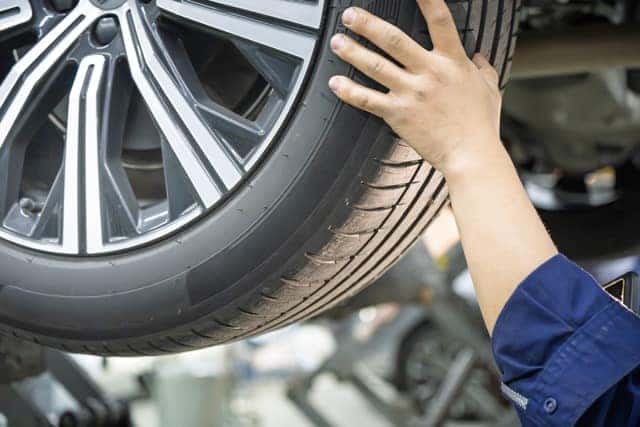
Four independent tests, and any one of them failing means it is time.
Tread depth. The legal minimum in most states is 2/32 of an inch, and every tire has built-in wear bars — raised strips in the tread grooves. When the tread wears level with those bars, the tire is finished. The old penny test still works: insert a penny with Lincoln’s head pointing down, and if you can see the top of his head, you are at or below 2/32.
Worth knowing: wet-weather performance falls off well before 2/32. Braking distance on a wet road with 4/32 remaining is meaningfully longer than with new tires. In a region that gets Alabama’s rainfall, planning replacement around 4/32 rather than waiting for 2/32 is a defensible safety decision.
Age. Rubber degrades on a calendar, not just under load. Most manufacturers recommend replacement at six years and treat ten as an absolute maximum regardless of appearance or tread. Every tire has a DOT code on the sidewall ending in four digits — week and year of manufacture. A tire marked 3122 was made in the 31st week of 2022.
Visible damage. Sidewall cracking, bulges, blisters, cuts or embedded objects. A bulge means the internal structure has failed and the tire can let go without warning. Replace it immediately.
Uneven wear. Wear concentrated on the edges, in the center, or on one shoulder tells you something else is wrong — pressure, alignment or a suspension component. Fix the cause or the new tires will wear the same way.
How often should tires be rotated?
Every 5,000 to 8,000 miles for most vehicles, which conveniently lines up with the oil change interval on many maintenance schedules.
Rotation matters because tires do not wear evenly by position. Front tires on a front-wheel-drive vehicle handle steering, most of the braking and all of the acceleration, so they wear faster than the rears. On rear- and all-wheel-drive vehicles the pattern differs but the principle holds. Moving tires around distributes wear and extends the life of the whole set.
Two practical notes. Some vehicles use different tire sizes front and rear, which limits rotation options. And all-wheel-drive vehicles are particularly sensitive to mismatched tread depths across axles — a significant difference can stress the driveline. If you damage one tire on an AWD vehicle, ask about matching the others rather than assuming a single replacement is fine.
Rotation is also the cheapest opportunity to have someone look closely at all four tires and spot a developing problem.
Why does my tire pressure light come on when it gets cold?
Because air contracts when it cools. Tire pressure drops roughly one PSI for every ten-degree Fahrenheit fall in ambient temperature.
Birmingham can swing 25 or 30 degrees between a warm October afternoon and a cold morning a week later, which is enough to take a properly inflated tire below the threshold that triggers the monitoring light. Nothing is leaking. The air just got colder.
What to do about it:
- Check pressure when tires are cold, meaning before driving or at least three hours after
- Inflate to the pressure on the driver’s door jamb placard, not the number moulded into the tire sidewall — that sidewall figure is the tire’s maximum, not the vehicle’s recommendation
- Check monthly through the cooler months rather than waiting for the light
- Do not let air out on a hot afternoon; pressure rises with heat and you will be underinflated the next morning
Underinflated tires wear the shoulders, use more fuel, handle worse and build heat, which is the main cause of catastrophic tire failure. The monitoring light generally only triggers well below the recommended pressure, which means by the time it comes on you have been driving underinflated for a while.
Do I need an alignment?
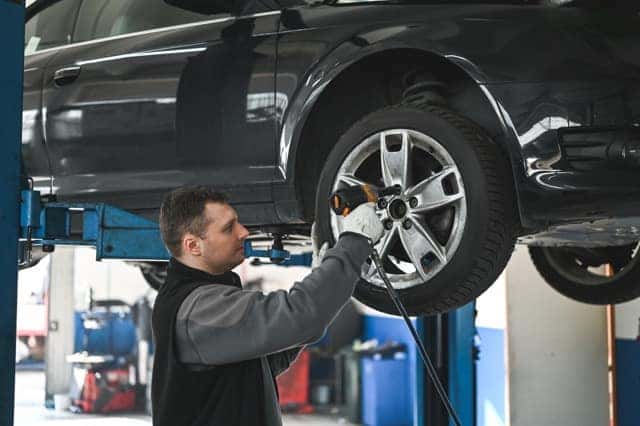
Alignment is separate from tires but directly determines how long they last.
Signs you need one:
- The vehicle pulls to one side on a flat, straight road
- The steering wheel sits off-center when driving straight
- Uneven tire wear, especially on one edge
- The steering feels loose or wanders
Alignment is worth checking after hitting a significant pothole, after any suspension work, whenever new tires are fitted, and periodically on vehicles with solid front axles such as the Wrangler and Gladiator, which are more sensitive to it than independent-suspension vehicles.
Paying for an alignment when you fit new tires is cheap insurance. Skipping it and discovering the misalignment after a set has worn out unevenly is expensive.
Choosing replacement tires
Three decisions, in order of how much they matter:
Type. All-season tires suit the overwhelming majority of Birmingham driving. All-terrain tires make sense on a truck or Jeep that actually leaves pavement, at the cost of road noise, tread life and fuel economy. Performance tires grip better and wear faster.
Size. Stick with the size on the door placard unless you have a specific, considered reason to change. Different sizes affect speedometer accuracy, driveline geometry, braking performance and, on some vehicles, the driver assistance systems.
Load and speed rating. Trucks and towing vehicles need tires rated for the load. This is not a place to economize — an underrated tire on a truck that tows is a real hazard.
Our Service Center handles rotations, balancing and replacement. You can schedule service online, use the Express Lane for a rotation, check service and parts specials, or order parts directly.
Frequently asked questions
When should I replace my tires? When tread depth reaches 2/32 of an inch, when there is sidewall cracking or a bulge, or at roughly six years of age regardless of remaining tread. In wet climates, planning replacement around 4/32 improves wet braking meaningfully.
How often should tires be rotated? Every 5,000 to 8,000 miles for most vehicles, which usually means at every oil change. Tires wear unevenly by position, and rotating distributes that wear across the set.
Why does my tire pressure warning come on in cold weather? Air contracts as it cools, and tire pressure falls roughly one PSI for every ten-degree drop in temperature. A cold snap can take a properly inflated tire below the warning threshold without any leak.
What pressure should my tires be? Use the figure on the driver’s door jamb placard, which is the vehicle manufacturer’s recommendation. The number moulded into the tire sidewall is the tire’s maximum pressure, not the correct operating pressure.
Do old tires need replacing even with good tread? Yes. Rubber degrades over time regardless of use. Most manufacturers recommend replacement at six years and treat ten as an absolute limit. The DOT code on the sidewall gives the week and year of manufacture.
0 comment(s) so far on When to Replace Your Tires, How Often to Rotate, and Why Cold Weather Drops Your Pressure